Every rare book has its own history and some of ours have been around for more than five hundred years. In that time they have often travelled far and wide, passing through many different hands. Previous owners of our early printed books have left their mark in lots of ways; some inscribed their name on the title page, others doodled in the margins, or added a personal bookplate. Other ownership evidence we see is more ephemeral. How often have you used a shop receipt, a postcard, or a post-it note as an impromptu bookmark? Readers in earlier centuries were no different and often grabbed any nearby scrap of paper to mark their page. They also used their books as handy places to store notes and correspondence, to keep prints and drawings safe, and even to press dried leaves and flowers. In Cardiff’s Special Collections and Archives we often come across such items hiding between the pages while we catalogue our rare books and it is these little transient scraps that bring to life the people who owned, used, and treasured our books so many years before us.
A reader’s bookmark left in Rudolph Ackermann’s “The repository of arts” (1809)
Flowers and leaves
Books are perfect for pressing dried flowers, leaves and plants and these are among our most common ephemeral finds. Early printed herbals are often found to contain dried examples of the plants they describe, presumably collected by the reader to further assist with identification. A recent favourite, however, was a biblical text with a fig leaf placed modestly over an illustration of Adam and Eve in the Garden of Eden!
Fig leaf in “Exposition of the Old and New Testaments” (1793)
There are pressed leaves scattered throughout our 1705 “Amaltheum botanicum” by Leonard Plunkett
Letters and notes
Letters found stored in rare books are often unrelated to the text, but sometimes they provide us with useful clues about why a book was purchased or donated and who originally owned it. The most helpful include a detailed bibliographical description and provenance history for the volume. Handwritten notes in books however can include anything from diary entries to shopping lists and recipes. Our copy of John Gauden’s The whole duty of the communicant (1696) contained a hand-drawn map of the city of Bath plus the names of local residents.
“A new plan of ye city of Bath”
“With all best remembrances to your circle”: This donation letter accompanied Edward King’s “Observations on ancient castles” (1782)
Paintings and prints
Heavy books have long been convenient places to keep paintings, drawings or prints flat and safe from damage. One very unusual find was hundreds of designs for dishes and ceramics pasted into a 1679 book of sermons, virtually obscuring all the text. More recently we discovered these wonderful hand-painted goldfish which were, quite aptly, tucked into an eighteenth century work on marine life.
Colourful fish in “Coloured figures of marine plants, found on the southern coast of England” (1795)
Designs for dishes and plates pasted into Paolo Segneri’s “Quaresimale di Paolo Segneri della Compagnia di Giesu” (1679)
Newspaper clippings
Articles and cuttings from newspapers are very common finds. Sometimes they relate closely to the text or the author, but often it is hard to determine any relevance to the book; it was just a handy place to store something that caught the reader’s eye!
“The whole duty of man” (1735) by Richard Allestree, a small octavo volume, was packed full of newspaper clippings and other objects
Playing cards
These little bookmarks are actually hand-drawn playing cards for an Italian card game called scopa. They were found throughout the pages of our 1599 edition of Ptolemy’s Geographia.
Scopa cards in our copy of Ptolomy’s “Geografia di Claudio Tolomeo Alessandrino” (Venice, 1599)
As fascinating as our rare publications are to work with, occasionally the contemporary advertisements they contain can be even more remarkable than the text itself. One example is this advert for William Berry “Willy” Clarkson (1861-1934), a theatrical costume designer and wigmaker, which can be found on the back cover of a play in the Cardiff Rare Books Collection.
Wigs! Wigs!! Wigs!!! Advertisement for W. Clarkson, Theatrical and Mechanical Wig Maker (ca. 1885)
Clarkson’s father had been in the wigmaking business since 1833 and the company was already a fixture of the theatrical world when Willy took over in 1878, but he quickly lifted the business to new heights. He added costumes and makeup departments and began supplying wardrobes for entertainments at Windsor Castle and Balmoral, eventually being rewarded with a prized appointment as “Royal Perruquier and Costumier.” With more than 50,000 costumes in his stores and 100 staff in his factory, Clarkson provided the wigs and outfits for the majority of the West End theaters for over half a century; by 1900 an article in theatrical paper The Era could claim that “Scarcely any big production in London is undertaken without the aid of the owner of the Wellington-street wiggeries”.
While Willy Clarkson’s success in business was undoubtedly impressive, his extra-curricular activities belong in a Sherlock Holmes novel. As an acknowledged expert in costuming and a master of disguise, it should be no surprise that the police in Scotland Yard were aware of Clarkson’s work and even made use of his skills to obtain disguises for detectives. He was proud of having assisted police in catching Herbert John Bennett, who was sentenced to death in 1901 for strangling his wife on Yarmouth beach. However Clarkson was long suspected of working both sides of the law; Bennett had in fact been one of Clarkson’s clients and was just one of several notorious criminals with whom he was known to have associated. The wigmaker himself admitted to crafting cunning disguises for Dr Crippen as well as the doctor’s wife and eventual victim, actress Cora Turner. He was also certain he had provided costumes for the serial killer known as Jack the Ripper – a recent theory even named Clarkson as a potential Ripper suspect (based on evidence considered tenuous at best)!
Postcard of the Cambridge Hoax, 1905
Clarkson provided costumes for two famous turn-of-the-century hoaxes. In 1905 he helped two undergraduates convince the mayor of Cambridge that the Sultan of Zanzibar was visiting the city. Much to their amusement, the mayor provided the heavily disguised students with an official welcome and a tour of the colleges. A few years later in 1910 Clarkson assisted the members of Horace de Vere Cole’s Dreadnought hoax, in which a party of pranksters duped the Royal Navy into giving them a tour of their most powerful warship. Among these hoaxers was a young Virginia Woolf, disguised by Willy Clarkson as a member of an Abyssinian royal delegation complete with turban, caftan, and grease paint (a costume which, of course, would be highly offensive today).
When he wasn’t playing pranks or disguising nefarious criminals Clarkson was reputedly committing a few crimes of his own, notably arson and insurance fraud. No fewer than eleven out of the twelve premises he occupied are believed to have burnt down in dubious circumstances, prompting large claims for compensation. Insurance companies became suspicious and gathered enough evidence to prosecute the wigmaker for fraud, but he died in 1934 before the prosecution could take place. During the trial against his estate, it emerged that Clarkson had reported six further fires and one gas explosion. It is hard to deny that the Wigmaker of Wellington-street lived a remarkable life and went out with a bang!
The cover of Dicks’ Standard plays in which Clarkson was advertising in 1885
William Lithgow has been described as one of Scotland’s greatest travellers. He was born around 1582, the son of a Lanarkshire merchant, and began his explorations in his youth with walking trips through the Orkney and Shetland Islands. Lithgow would go on to cover a staggering 36,000 miles on foot, however his life as an itinerant wanderer was not entirely by choice. Having inherited a house and some land through his mother’s death, Lithgow then set about trying to seduce a beautiful young woman called Miss Lockhart. Her four brothers were furious when they caught him in the act and they had him cast out of town, but not before cutting off his ears (his ‘lugs’ in Scots). From this time on the unfortunate William Lithgow was better known to all as ‘Lugless Will’.
William Lithgow in his Turkish dress
After a bit of soul-searching over his lost love, Lithgow decided he might as well become a travelling merchant and see more of the world. Having already explored the Scottish islands, he set off in 1609 to walk to Germany, Bohemia, and the Low Countries, before finally arriving in Paris. The following year he walked to Rome and undertook the first of several major excursions, an epic journey that took him to Greece, Egypt, Malta and the Middle East. Over the next nineteen years he continued to travel extensively throughout England, Scotland and Ireland, central Europe, and North Africa. According to Lithgow’s own reports, these wanderings saw him experience numerous adventures and suffer considerably more than his fair share of misfortunes. On his way to Rome, he was apprehended by a band of robbers; the story goes that the would-be thieves found Lugless Will so lacking in funds that they took pity on him and ended up giving him money instead!
Robbed and stripped by Hungarians in Moldovia
On reaching the city, Lithgow was then pursued by the Spanish Inquisition and narrowly escaped with his life by climbing the city walls. Having come into some money he was almost immediately robbed again in Moldovia by six bandits, who even relieved him of his treasured Turkish clothes. In another of his increasingly fantastical tales Lithgow claims to have been shipwrecked on a voyage from Italy to Constantinople, managing to save his papers and belongings only by floating them in his portable wicker ‘coffino’. These survival skills also allegedly came in handy when a party he was with got lost in the Libyan desert and heroic Will had to guide them to safety. As some small recompense for hardships endured, when he finally reached Constantinople Lugless Will reportedly became the first European ever to sample coffee!
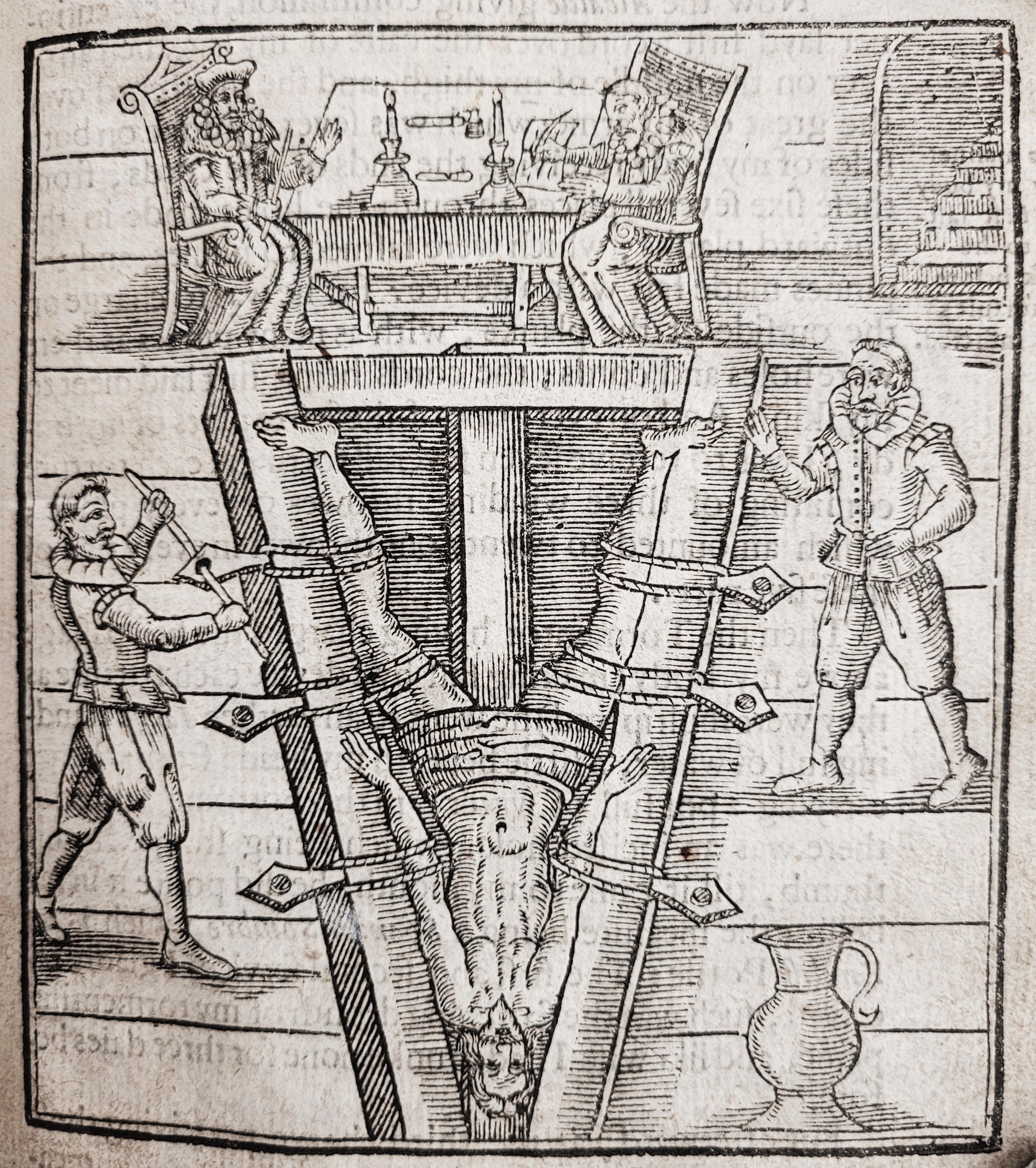
Lithgow stretched on the rack in Malaga
Having continued his travels to Malaga, Lithgow was quickly imprisoned as a spy and endured weeks of captivity and brutal torture on the rack until his captors, realising he was completely innocent of the charges, helpfully handed him over to the Inquisition where he was subjected to even more vicious torture. The British ambassador finally secured his release and Will, now a physically and mentally broken man, proceeded to London to seek redress for false imprisonment. Unfortunately, when he was taken to confront the Spanish ambassador Will attacked him, resulting in a diplomatic incident for which he was immediately clapped in irons again. Upon his final release Will returned swiftly to Scotland, where he reportedly (and probably sensibly) remained until his death in 1645.
Clapped in irons at the Governer’s palace in Malaga
William Lithgow produced various poems and pamphlets about his travels, but his major published work is The totall discourse of the rare adventures and painefull peregrinations of long nineteene years travayles, an autobiography first printed in draft in 1614 and published more fully in 1632. The book details (in frequently ostentatious prose) Lugless Will’s trials and tribulations across “forty eight kingdomes ancient and modern; twenty one rei-publicks, ten absolute principalities, with two hundred islands” and includes much well-considered detail about the cultures and customs he encountered alongside the more fanciful tales. Lithgow was fluent in French, Italian, Spanish and Latin, and was a careful observer who got on well with the people he encountered regardless of race or religion (occasional tirades about the Pope notwithstanding).
Befriending the locals in the ancient city of Fez
Cardiff University Special Collections holds a copy of the revised edition printed in 1640 which itself has led an interesting life and travelled through a number of different hands. The book was once owned by the Dewar family, known around the globe for the Dewar’s Scotch whisky empire.
Front pastedown with provenance evidence
On the front pastedown is the bookplate of Thomas W. Dewar, director of several Dewar’s companies. His son Captain J. B. W. Dewar, who served in the Cameronians and suffered shellshock in the First World War, has inscribed the page in pencil underneath: “John Dewar Harperfield 1927”. A red and black book label of Castlecraig Library on front pastedown (motto “Fax Mentis Honestae Gloria”) suggests that before the book reached the Dewars it had been held in the library at Castlecraig in Peebleshire, the home of Sir Thomas Gibson-Carmichael (1859-1926), 1st Baron Carmichael and a former Colonial Governor of Victoria.
Lithgow, William, The totall discourse of the rare adventures & painefull peregrinations of long nineteene yeares travayles from Scotland to the most famous kingdomes in Europe, Asia and Affrica, Glasgow: University Press, 1906: https://www.gutenberg.org/files/61545/61545-h/61545-h.htm#pb328 (accessed December 15, 2023).
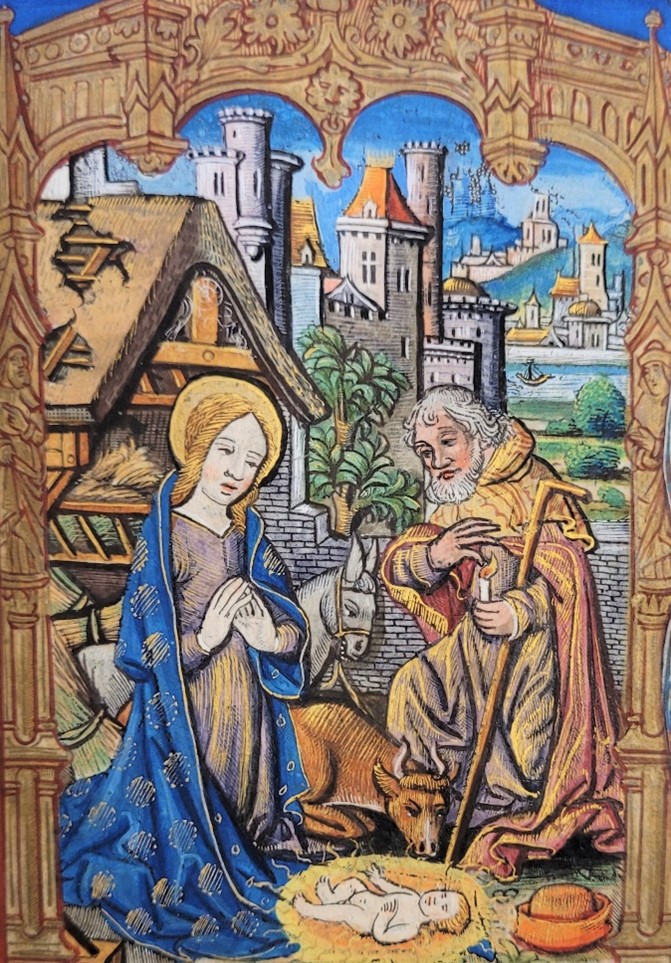
Books of Hours were personal prayer books that were hugely popular in the late Middle Ages and the early Renaissance. These books, also known as Horae (Latin for “hours”) were based on the Hours of the Blessed Virgin Mary, a set of devotional texts to be read at specific times of the day and night, and were often illustrated with pictures designed to focus prayer. Horae usually contained several other texts, such as prayers to saints, a calendar of feasts, and extracts from the Gospels. Wendy Stein has suggested that in addition to being beautiful to look at and acting as bookmarks to highlight the beginning of each section, the illustrations also formed a ‘painted prayer’ to help focus the reader’s devotions.
Visitation of the Blessed Virgin Mary to St Elisabeth
More Books of Hours were produced in the Middle Ages than any other type of book, and many thousands survive today in libraries and museums as testament to their popularity. Extravagantly bound and lavishly illustrated copies written on large leaves of vellum were produced for nobility and royalty, but most Books of Hours were made for everyday use and were relatively compact, often small enough to be carried on the person. You still had to be reasonably wealthy to own one though; the prohibitive costs of materials and the expensive labour of scribes and illuminators ensured that manuscript Books of Hours remained out of reach even for many professionals and merchants.
The Zodiac Man was used in medieval medicine to determine the correct time for surgery, medication, and bloodletting
The annunciation to the shepherds
With the advent of the printing press and the development of movable type in the mid-1400s, mass production of texts was finally possible, and books became more economical to produce and much easier to get hold of. Books of Hours continued to be popular as they became accessible to a much wider range of people. Although Horae were produced by printers all over Europe, Paris soon established itself as the centre of production and some estimates suggest that up to 1,600 different editions were published between 1480 and 1530. Here in Cardiff University’s Special Collections and Archives we hold a stunning example printed in 1507 by Thielmann Kerver and now fully digitised here. Kerver was a highly successful Parisian publisher and ran a business which his family had owned for generations. He began printing Books of Hours in the early 16th century. Rather than using woodcuts for the illustrations, Kerver preferred to employ metal plates which, when mounted on wooden blocks, could also be printed along with the letterpress text. These segmented borders and images could be arranged in different groupings and reused for future editions.
Kerver incorporated many elements of the manuscript tradition into his printed works. Illuminated illustrations were such a large part of the appeal of the Book of Hours in the medieval period that it is perhaps not surprising to find that the earliest printed Horae are illustrated with woodcuts and metalcuts and that these were sometimes overpainted by hand in imitation of a manuscript. The elaborate hand-painting makes it difficult to even see the printed metalcuts beneath; they have largely acted only as a template for the illuminator.
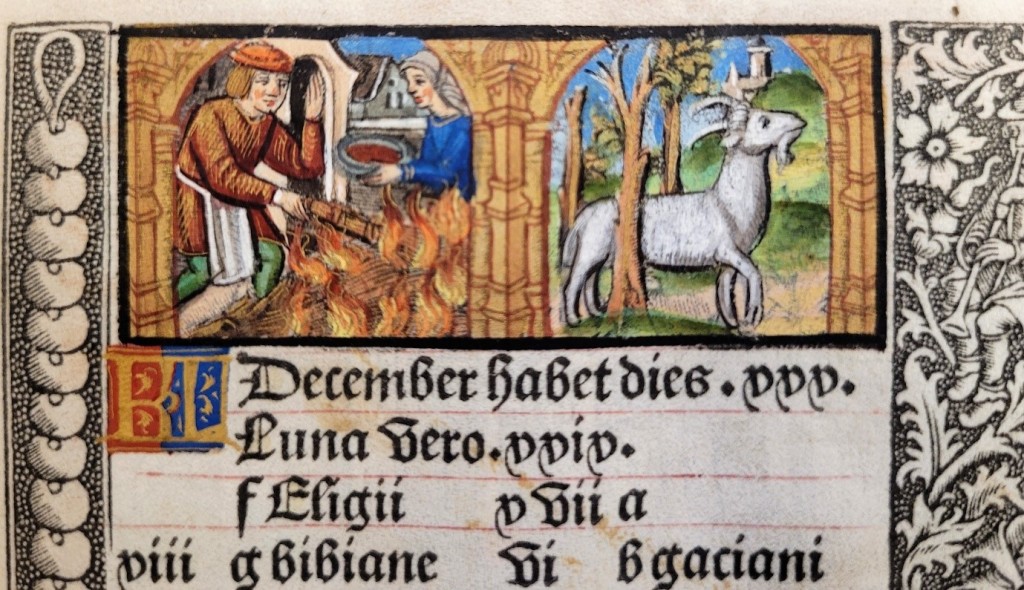
Medieval calendar pages show the labours to be performed each month. The unpainted metalcut borders are also visible
Additionally, rubrication (using red ink to highlight text) and coloured initial letters would still be added by hand because printing with multiple colours of ink was difficult and costly. Some of Kerver’s luxury editions were even produced on leaves made from vellum (calfskin), just as the manuscripts had been. Maureen Warren describes how these hybrid books “demonstrate how the new technologies of printing were used to complement—rather than rival or replace—traditional methods of artistic production”. Despite being mass-produced on the printing press, each beautifully illuminated Book of Hours, including Cardiff’s very own, can be considered a unique historical object in its own right.
Stein, Wendy A. “The Book of Hours: A medieval bestseller.” In Heilbrunn Timeline of Art History. New York: The Metropolitan Museum of Art, 2000: http://www.metmuseum.org/toah/hd/hour/hd_hour.htm (accessed 11 October, 2023).
This guest post is from Dr Melanie Bigold, Reader in English Literature in the School of English, Communication and Philosophy, Cardiff University.
The Cardiff Rare Books collection holds many texts which provide both provenance details (that is, information about former owners), as well as various types of evidence of historical use (for example, marginal annotations). Indeed, Cardiff’s collection is notable for the marked-up state of many of the books. Our librarian, Lisa Tallis, recently published an article on some examples from the Salisbury Collection in the Welsh History Review, and I have also written about marginalia in the Restoration Drama Collection.
My current research is on female book ownership between 1660-1820, so I have been revisiting the provenance details of hundreds of books in the Cardiff collection. One of the truly interesting tangential discoveries of research on women owners is that it has led me to the libraries of even more marginalised figures in the history of book ownership: servants and labouring-class individuals. For example, at Alnwick Castle, I discovered that a list mislabelled as one of the Duchess of Northumberland’s libraries was actually that of her servants. In the 1750s, Elizabeth Percy, first Duchess of Northumberland (1716-1776), made a list of the 131 books that she made available to her large household. The article about this exciting source is currently available open access here. A list of the 131 titles is also available open access on the Bibliographical Society’s website here.
As a result of the excellent work of rare books cataloguer, Christine Megowan, Special Collections and Archives at Cardiff has recently yielded a similar piece of evidence from 1815. The female owner of the library in question was Frances Ann Grey (née Pryce) (1780-1837), the heiress of Dyffryn House in Glamorgan, Wales. Frances’s father, Thomas Pryce, was a coal merchant who bought the estate in 1759 and christened it Dyffryn, but records for the estate and its various owners go back to the seventh century. Unfortunately, the eighteenth-century house that Frances lived in no longer exists, but the Victorian house and Edwardian gardens still known as Dyffryn House are now managed by the National Trust.
Thomas Pryce had two daughters: Frances, the eldest, born in April 1780, and the younger, Elizabeth, must have been born just over a year later as she is recorded as dying, age 21, in September 1802.[1] Their mother, also named Frances Ann, died in March 1782, age 32, perhaps due to complications in the birth of Elizabeth. Thomas Pryce died in 1789, leaving Frances as his heir. In 1802, Frances married William Booth-Grey (1773-1852) – the second son of George Harry Grey, 5th earl of Stamford, of Dunham Massey, Cheshire. Frances was likely the mechanism for this second son to acquire an estate, as William joined Frances at Dyffryn House and shortly became High Sherriff of Glamorgan. A watercolour portrait of the two is held in the National Trust collections at Dunham Massey and can be viewed here. The couple had no children and the estate passed back to a Pryce kinsman on Frances’s death in 1837.
Inscription: ‘For the use of the Servants At Duffryn 1815’.
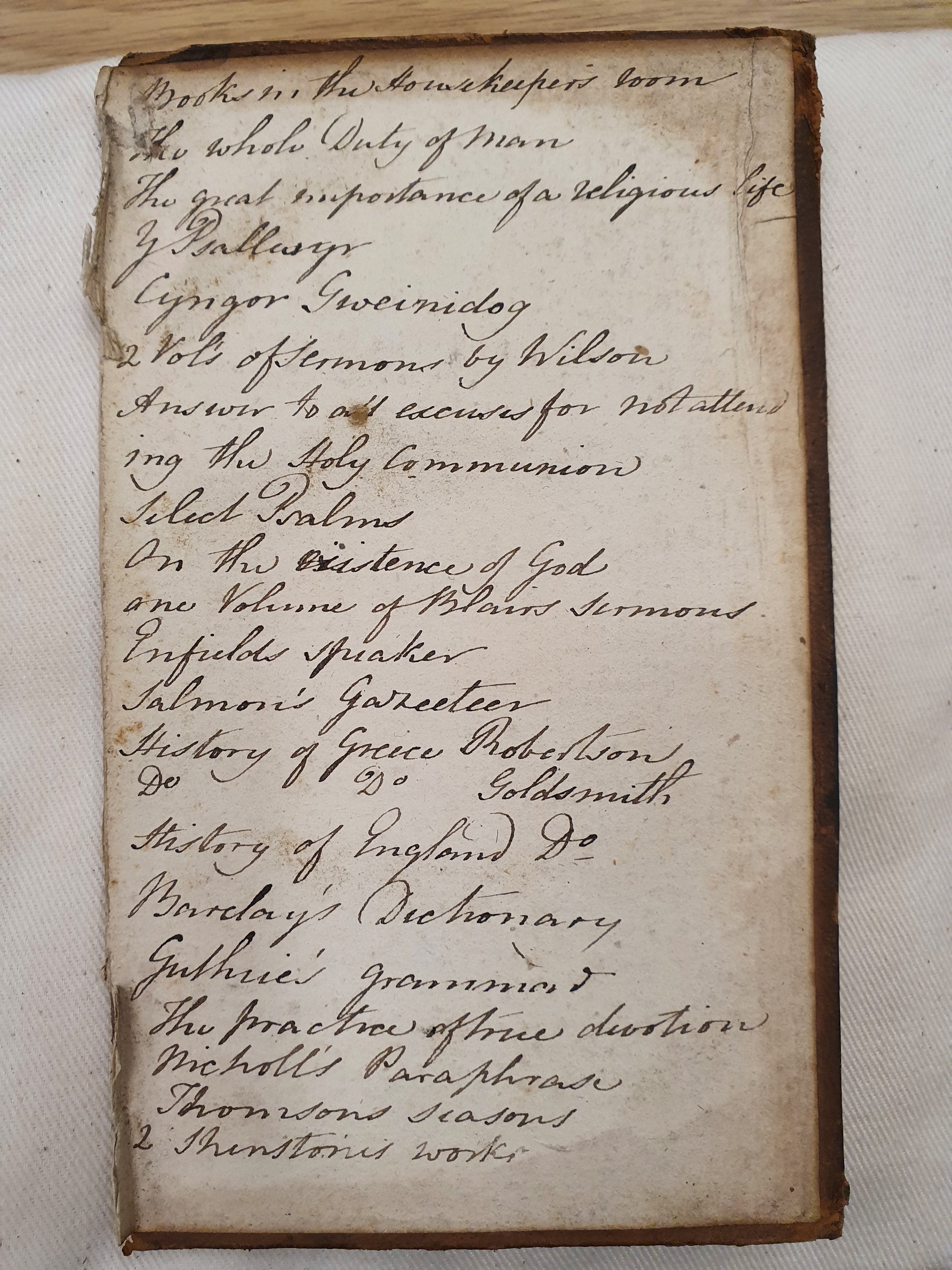
Beyond these scraps of information, not much is known about Frances, so it was wonderful to find a trace of her impact on the pages of one of our rare books. Special Collections has a single book that hails from Dyffryn House: a copy of Dr. Goldsmith’s history of Greece: abridged, for the use of Schools (London, 1787). The ink inscription on the front pastedown tells us that the book was ‘Mrs Grey’s’, and that it was ‘For the use of the Servants At Duffryn 1815’. In addition, on the final pastedown is a list of ‘Books in the Housekeeper’s room’, followed by the titles of twenty books, including the Goldsmith tome. In other words, this is a list of the library assembled by Frances for the benefit and entertainment of her servants. The titles include an interesting mix of histories, literature, religion, and reference works.
List of titles.
The Whole Duty of Man [Richard Allestree, first published 1658]
The great importance of a religious life [William Melmoth, first published 1711]
Y Psallwyr [Psalms of David]
Cyngor Gweinidog [William Holmes, The Country Parson’s advice to his parishioners, first published in English in 1742, and translated into Welsh in 1769]
2 Vol’s of Sermons by Wilson [probably Thomas Wilson, Thirty-three sermons published in Bath in 1791, in 2 volumes]
Answer to all excuses for not attending the Holy Communion [Edward Synge, An answer to all the excuses…, first published 1697]
Select Psalms
On the existence of God [unknown, several possible titles]
One Volume of Blairs Sermons [Hugh Blair, Sermons,first published 1777]
Enfields Speaker [William Enfield, The Speaker, first published 1774]
Salmon’s Gazeeteer [sic] [Thomas Salmon, The Modern Gazetteer,first published 1746]
History of Greece Robertson [William Robertson, The History of Ancient Greece, 1768]
History of Greece Goldsmith [Oliver Goldsmith, The Grecian History, was first published 1774. The abridged version present in the Cardiff collection came out in 1787]
History of England Goldsmith [first published 1764. Perhaps this was the abridgement in 12mo published in 1774]
Barclay’s Dictionary [James Barclay, A Complete and Universal Dictionary, first published 1774]
Guthrie’s Grammar [William Guthrie, A New Geographical, Historical, and Commercial Grammar, first published 1770]
The practice of true devotion [Robert Nelson, first published 1715]
Nicholl’s [sic] Paraphrase [William Nicholls, A paraphrase on the Psalter or Psalms of David, first published 1707]
Thomson’s Seasons [James Thomson, The Seasons, first published together 1730]
2 Shenstones Works [William Shenstone, The works in verse and prose, first published 1764]
It is impossible to determine the edition date for many of the titles, but apart from the books of Psalms; The Whole Duty of Man (1658), Richard Allestree’s perennially popular book of practical devotion; and Edward Synge’s An Answer (1697), all of the titles first appeared in the eighteenth century, and many in the latter half of the century. While this suggests a relatively current library, the date of the Goldsmith edition – 1787 – tells us that the books were probably second-hand copies. The other factor to note about our Goldsmith book is that it is small – not much larger than a smartphone. Known as duodecimo (12mo) format, it is similar in size to those found in other servant libraries from the eighteenth and early nineteenth centuries. For example, at Felbrigg Hall in Norfolk (a National Trust house) there is a servants’ library of twenty-five books in their own miniature, locked bookcase. These books are all duodecimo. This was a common size for chapbooks, the small and cheap little books sold by travelling pedlars or chapmen. Seen as ephemera, most early examples of these popular books have not survived. Margaret Spufford’s wonderful study, Small Books and Pleasant Histories: Popular Fiction and its Readers in Seventeenth-Century England (London, 1981), is still the definitive history on chapbooks. Sadly, our list does not contain any of the famous old chapbook titles.
Instead, in 1815, it is religious titles that dominate the list (11 of the 20 titles), but there is more variety here than other examples of nineteenth-century servants’ libraries. The Felbrigg servants’ library, for example, is entirely religious (all 25 texts were published by the Religious Tract Society). Frances’s selection, on the other hand, has more in common with the servants’ library at Alnwick Castle. Like the duchess, Frances provided her servants with books of a practical nature; that is, works that could help them learn about the world as well as advance their job prospects. For example, there is a book to help the servants learn to read. The long title of William Enfield’s The Speaker (item 10) explains that it contains ‘miscellaneous pieces, selected from the best English writers… with a view to facilitate the improvement of youth in reading and speaking.’ There are also general knowledge dictionaries and grammars. James Barclay’s ‘Dictionary’ (item 15) is not just a dictionary of words and definitions in the modern sense, but also contained a history of ‘the counties, cities, and market towns in England, Wales, and Scotland’, ‘a sketch of the constitution, government, and trade of England’, and ‘an outline of antient and modern history’. Likewise, Guthrie’s ‘Grammar’ (item 16) provided geographical knowledge about the ‘Land and Water, Continents and Islands’, ‘Climate, Air, Soil, vegetable Productions, Metals, Minerals’, among other things. The Modern Gazetteer (item 11) was another work of geographical and historical knowledge, written by a man who circumnavigated the world with George Anson in the 1740s. These works imparted general knowledge about the world beyond Wales, and as such provided both instruction and entertainment.
For those who had mastered their reading, there was also more ambitious fare in the form of James Thomson’s celebrated long poem, The Seasons (item 19), as well as William Shenstone’s collected works (item 20). Thomson’s paeon to the natural world was ubiquitous in eighteenth-century country house libraries; Shenstone, however, appears less frequently. Nevertheless, he wrote in the same vein as Thomson, with a focus on the countryside, rural life, and sensibility, and the appearance of these two authors suggest an interest (either from Frances or among the servants) for poetry with a connection to the land. They also hint at the preference in Welsh homes for poetry over novels. In my study of women’s libraries in Wales, poetry was almost always more prevalent.
There is also a focus on history which is one of the most popular genres in women’s libraries in the period. In addition to the Cardiff copy of Oliver Goldsmith’s abridged history of Greece (item 13), the list also mentions Goldsmith’s history of England (item 14), and another history of Greece from William Robertson (item 12). Goldsmith’s and Robertson’s Grecian histories were adaptations of the French classic Histoire Ancienne (1730-38) by Charles Rollin. This popular source was translated as well as abridged into many different languages over the course of the eighteenth century. Goldsmith, who was always short of funds and in search of publishing opportunities, produced a novelistic version that does not credit its source, while Robertson, Keeper of the Scottish Records, attempted a more traditional historiography that, in its second edition, credited his source as a French abridgement of Rollin.[2] The appearance of these three histories show that eighteenth-century publishers were responding to and creating a popular history market for readers of all ages and abilities.
However, the most unique aspect of this list is that it contains Welsh-language texts. This is the earliest example I have found of Welsh texts in a country house servants’ library. These include, ‘Y Psallwyr’ (item 3), which is the Welsh translation of the Psalms of David, and ‘Cyngor Gweinidog’ (item 4), a translation of William Holmes’ work, The Country Parson’s Advice to his Parishioners. This tells us that there were Welsh speakers among Frances’ servants, and, perhaps more importantly, that she supported them with their own Welsh-language texts. It likewise reveals the expansion of Welsh-language publishing.
In her study of two English provincial booksellers, Jan Fergus notes that, among the working classes, servants often had the most leisure time and that they tended to be more literate.[3] Frances Grey’s list confirms such literacy for both English and Welsh speaking servants. It also shows the extent to which women like Frances supported the members of her household in improving and extending their reading. Now if only I could find the list of her library.
[2] Giovanna Ceserani, ‘Narrative, Interpretation, and Plagiarism in Mr. Robertson’s 1778 “History of Ancient Greece”’, Journal of the History of Ideas 66, no. 3 (2005): 413–36.
[3] Jan Fergus, ‘Provincial Servants’ Reading in the Late Eighteenth Century’, in The Practice and Representation of Reading in England, ed. James Raven, Helen Small, and Naomi Tadmor (Cambridge: Cambridge University Press, 1996), 202–25, 204.
Mae casgliad arbennig o lyfrau cain – gwaith oes yr artist Shirley Jones – yn ganolbwynt ar gyfer gwasanaeth digidol newydd sbon, wedi’i ddatblygu gan staff Casgliadau Arbennig ac Archifau.
Mae Casgliadau Arbennig Ar-Lein, sy’n lansio heddiw, yn rhannu casgliadau prin gydag ymchwilwyr, myfyrwyr, ysgolion a’r cyhoedd yn rhad ac am ddim.
Bydd casgliadau prin ac unigryw i’w gweld ar-lein, rhai am y tro cyntaf erioed
Gyda dros 1,700 o eitemau prin wedi’u cyhoeddi yn barod, mae’r gwasanaeth yn hwyluso mynediad fel erioed o’r blaen, gan ddefnyddio ffotograffau manwl a phrydferth. Mae llawer o’r eitemau sydd i’w canfod ar y gwasaneth yn hynod o brin, ac eraill yn hollol unigryw i’r Brifysgol.
Meddai’r Archifydd Alison Harvey: “Mae llyfrau Shirley i’w canfod mewn casgliadau preifat – mae’n weithred radical i’w rhannu gyda phawb, ar-lein, am ddim – gwaith oes, sy’n cael ei rannu gyda bendith Shirley.”
Golwg fanwl ar waith yr artist Shirley Jones, sydd wedi gwneud rhodd o’i gwaith oes i’r Brifysgol
“Mae’n wahanol iawn i sganiau llwyd y dyddiau a fu: dylunwyd y gwasanaeth i gyd-weithio gyda systemau eraill, sy’n cynyddu’r potensial ar gyfer creu deunyddiau dysgu, arddangosfeydd rhithiol, ymchwil a llawer mwy.”
Bydd Casgliadau Arbennig Ar-Lein yn tyfu wrth i ragor o eitemau gael eu digido, gan greu trysorfa o ddeunydd ymchwil, a chasgliadau nodweddiadol fydd o ddiddordeb i lyfr-bryfaid yng Nghymru a thu hwnt. Ymysg eitemau eraill sydd ar gael am y tro cyntaf ‘mae:
ffotograffau unigryw o fyfyrwyr Ysgol Dechnegol Caerdydd ym 1898
dyddiaduron nyrs o Ryfel Cartref Sbaen
cofnodion lliwgar o fywyd myfyrwyr dros y degawdau
Myfyrwyr Ysgol Dechnegol Caerdydd ym 1898
Esboniodd Pennaeth Casgliadau Arbennig ac Archifau, Alan Vaughan Hughes: “Rydan ni’n falch iawn i fod yn rhan o gyfundrefn IIIF, y Brifysgol gyntaf yng Nghymru i ymuno. Mae’n safon digido arloesol, fydd yn drawsnewidiol ar gyfer ymchwil a dysgu.”
“Mae hyn gymaint mwy na rhoi lluniau ar y we: trwy IIIF, rydan ni’n rhan o fframwaith ryngwladol sy’n gwneud ein casgliadau yn fwy hygyrch i ymchwilwyr a’r cyhoedd yn fyd-eang.”
A unique collection of handmade books – the life’s work of artist Shirley Jones – is the centrepiece of a brand-new digital service developed by Special Collections and Archives.
Cardiff University Digital Special Collections, which launches today, is free to use and shares rarely seen treasures with researchers, students, schools and the public, for free.
Rare and unique items have been made available online for the first time, including the life’s work of artist Shirley Jones
Over 1,700 rare items are already available, photographed in exquisite detail – enabling access like never before to the University’s collections. Many of the items are extremely rare, while others are completely unique to the University.
Archivist Alison Harvey said: “Shirley’s books are usually in private collections, and it’s quite radical to make them available to everyone, for free, online – a lifetime of work, which we’re sharing with Shirley’s blessing.”
A detail from Shirley Jones’ collections, viewed through a deep zoom viewer, which lets users explore rare and unique collections in detail
“It’s a long way from the greyscale scans of the past: Digital Special Collections is designed to work with other platforms, to create teaching materials, online exhibitions and more. The potential for future research and impact is immense.”
Digital Special Collections will continue to grow as more items are digitised, creating a trove of research material and cultural highlights for book-lovers across Wales and beyond. Other items made available for the first time today include
unique photographs of students learning trades at Cardiff Technical School in 1898
handwritten diaries from an intrepid nurse, written during the Spanish Civil War
retro photographs of student life stretching back to the Victorian period
Cardiff Technical School Students in 1898
Head of Special Collections and Archives, Alan Vaughan Hughes explains: “We’re really proud to be the first University in Wales to adopt the IIIF standard. This framework allows the kind of functionality that will transform how we use collections for teaching and research.
“This goes way beyond just putting images on the internet: IIIF means that our collections are now part of an international framework and makes them more accessible globally, to researchers and the public.”
Rydym yn falch o ddatgan bod taith newydd ar gael, sy’n rhoi golwg ar hanes menywod Canol Dinesig Caerdydd.
Mae Parc Cathays yn gartref i brif Gampws y Brifysgol, yn ogystal â Neuadd y Ddinas, adeiladau’r Llywodraeth a’r Amgueddfa – ardal sy’n gysylltiedig â dynion pwerus hanes y brifddinas.
Map Hanes Menywod gan Frank Duffy, rhan o’r daith y gellid ei lawrlwytho am ddim
Ond edrychwch yn ofalus, a mi welwch bod hanes menywod ym mhobman, yn ffabrig ein gofodau dinesig.
Os ydych chi’n gweithio, astudio neu’n ymweld â Pharc Cathays: lawrlwythwch y daith am ddim, a mynd am dro hamddenol, heb risiau, o amgylch y Canol Dinesig.
Datblygwyd y daith ar y cyd ag Archif Menywod Cymru, sydd wedi creu dwsin o deithiau hanes menywod – o Fangor i’r Barri, gallwch lawrlwytho teithiau am ddim i archwilio hanes menywod ar draws Cymru.
Am fwy o wybodaeth am fersiwn dywysiedig o’r daith hon, dilynwch ni ar twitter am fwy o wybodaeth.
We’re excited to announce that a new self-guided tour is available, giving a glimpse into women’s history in Cardiff’s Civic Centre.
Home to the main University Campus, as well as Government buildings, City Hall and institutions such as National Museum Cardiff, it is an area known for its dazzling white buildings and its association with the ‘great and the good’ of the city’s past – mostly men on plinths with big moustaches.
Women’s History Map by Frank Duffy, part of the downloadable tour
However, look closely, and you’ll see that women’s history is everywhere, woven into the fabric of our public spaces. From activists to scientists, musicians to militant suffragettes – this tour brings together a snapshot of women’s history in Cardiff.
Whether you work, study, or visit at Cathays Park: download the tour for free, and take a leisurely, step-free route around the Civic Centre.
This tour was developed in partnership with Women’s Archive Wales, who have produced twelve women’s history tours – from Bangor to Barry, you can download a tour for free to explore women’s history across Wales.
For information about future guided versions of this tour, please follow us on twitter for more updates.
Y botanydd Maria Dawson oedd y person cyntaf i dderbyn gradd gan Brifysgol Cymru, ym 1896.
Dawson oedd y cyntaf, ar y cyd ag un arall, i dderbyn teitl Doethur y Gwyddorau gan Brifysgol Cymru, a derbyniodd ysgoloriaeth wyddonol i barhau ei hastudiaethau ym maes gwrtaith ac amaeth.
Miss Dawson yn derbyn ei Doethuriaeth, o gylchgrawn Coleg Prifysgol Caerdydd, Rhagfyr 1900
Gwobrwyo Graddau Cyntaf Cymru
Ym 1892, ymunodd Dawson a Choleg Prifysgol De Cymru a Sir Fynwy (y sefydliad a ddaeth cyn Prifysgol Caerdydd) i astudio mathemateg, cemeg, sŵoleg a botaneg.
Ar yr adeg honno, doedd dim hawl gan y Coleg i roi graddau, felly byddai’r myfyrwyr yn sefyll arholiadau Prifysgol Llundain fel rheol.
Ym 1893, sefydlwyd Prifysgol Cymru, fyddai’n newid byd addysg Cymru am byth, gyda Cholegau Prifysgol Aberystwyth, Bangor a Chaerdydd yn aelodau. Golygai hyn y gallai Maria Dawson gael gradd gan sefydliad Cymreig.
Perfformiad Academaidd
Roedd Dawson yn fyfyrwraig ddawnus: mi enillodd wobr arddangosfa (ysgoloriaeth) am safon ei harholiad mynediad, a dalodd am ei ffïoedd i gyd – ac enillodd un arall ar ddiwedd y flwyddyn.
Roedd ganddi ddawn wyddonol, gan ennill gwobrau yn ei phedwar pwnc yn ystod ei hail flwyddyn.
Labordy Cemeg yng Nghaerdydd ym 1899 yn dangos dynion a merched yn derbyn addysg
Ymchwil Arloesol
Wedi iddi raddio gyda B.Sc., enillodd wobr o £150 gan Gomisiwn Brenhinol Arddangosfa 1851.
Yn Labordai Botanegol Caergrawnt, fe aeth ati i ymchwilio effeithiau nitrogen ar blanhigion, oedd yn arfer newydd iawn ar y pryd.
Yn ei phapur ‘”Nitragin and the nodules of leguminous plants” ei damcaniaeth oedd na ddylai ychwanegu nitrogen yn ormodol i bridd, ond bod ei ddefnydd mewn pridd gwael yn gallu cynyddu cynaeafau.
Merched Parchus Neuadd Aberdar
Efallai na fyddai Dawson wedi dod i Gaerdydd oni bai am y neuadd breswyl arbennig ar gyfer menywod, Neuadd Aberdâr.
Darlun artist o Neuadd Aberdar fel yr edrychai ym 1895
Roedd ei theulu yn byw yn Llundain – rhy bell iddi ddychwelyd adre bob dydd – a roedd yn annerbyniol yn ôl moesau’r oes i fyfyrwraig ddi-briod fyw ar ei phen ei hun.
Sefydlwyd Neuadd Aberdâr ym 1885, un o’r neuaddau preswyl cyntaf yn y DU i fenywod.
Seremoni Raddio gyntaf Prifysgol Cymru
Cylchgrawn cyntaf Coleg y Brifysgol, Rhagfyr 1885
Ar yr 22ain o Hydref 1897, ymgasglodd myfyrwyr Prifysgol Cymru yn Neuadd y Parc, neuadd gyngerdd fawr, ar gyfer seremoni raddio gyntaf y sefydliad.
Dyma oedd gan gylchgrawn Coleg Prifysgol De Cymru a Sir Fynwy, cyhoeddiad gan fyfyrwyr, i’w ddweud am yr achlysur arbennig hwn:
“The first to be presented was Miss Maria Dawson, for the degree of B.Sc., and her appearance was the signal for a great outburst of enthusiasm among the audience. The Deputy-Chancellor… gave her the diploma…, and with a… bow… she retired amid deafening cheers.”
Rydym ni’n dathlu Maria heddiw, a’n falch o’n hanes hir o gefnogi ymchwil menywod yn y gwyddorau – cewch weld rhagor o straeon o fenywod sy’n arloesi heddiw fan hyn: Diwrnod Menywod Mewn STEM.
Gallwch ddarllen gwaith Maria Dawson am Nitrogen fan hyn: Maria Dawson, ‘“Nitragin” and the nodules of leguminous plants’, Proceedings of the Royal Society of London, Vol. 64, 167-168 (1899) http://doi.org/10.1098/rspl.1898.0086








 Special Collections and Archives / Casgliadau Arbennig ac Archifau